

Islip
Islip sits at a critical crossroads in Suffolk County where Route 111, Montauk Highway, and Sunrise Highway channel tens of thousands of vehicles through a compact hamlet every day. Collisions along these corridors cause serious, life-changing injuries to drivers, passengers, and pedestrians. Alonso Krangle LLP represents car accident victims in Islip and communities throughout Long Island, fighting to recover the compensation they need to rebuild their lives.

Crash Risks on Islip Roads
Islip is a hamlet within the Town of Islip in Suffolk County, situated along the South Shore of Long Island. Route 111 (Islip Avenue) runs north-south directly through the community, connecting Montauk Highway at the southern end to Central Islip and Hauppauge to the north. This two-lane state highway crosses over Sunrise Highway and the Southern State Parkway within Islip's boundaries, creating interchange zones where merging and weaving traffic produces frequent collisions. Main Street (NY 27A) carries east-west traffic through the heart of the hamlet, intersecting Route 111 near the LIRR station and local businesses. The intersection of Route 111 and Sunrise Highway is particularly hazardous. Vehicles entering and exiting the highway must navigate limited acceleration lanes while competing with local traffic. Sunrise Highway's high-speed design combined with the frequent signals along Route 111 creates dangerous speed differentials. Pedestrians crossing near the Islip LIRR station face additional risks, especially during morning and evening rush hours when commuters are hurrying to catch trains. The Heckscher State Parkway interchange just north of Sunrise Highway adds another layer of merging traffic to an already congested stretch. Suffolk County recorded 164 traffic deaths in 2022 — the highest of any county in New York State. Across Long Island, traffic fatalities rose approximately 40% since 2019, with one in three fatal crashes involving speeding and one in three involving alcohol. Nassau and Suffolk counties combined average 83 fatal or injury-causing accidents per day. These numbers underscore why anyone injured on Islip's roads should understand their legal rights and the compensation they may be entitled to pursue.
Local Hazard: Route 111's pavement condition through Islip has deteriorated significantly, with NYSDOT documenting extensive pothole damage along the stretch between Sunrise Highway and the Southern State Parkway. The agency has planned a full resurfacing project (Project 081703), but the timeline remains indefinite. Pothole-related crashes can involve vehicle damage and loss-of-control accidents. Alonso Krangle LLP's office in Melville is located just minutes north of Islip along the Route 110 corridor.
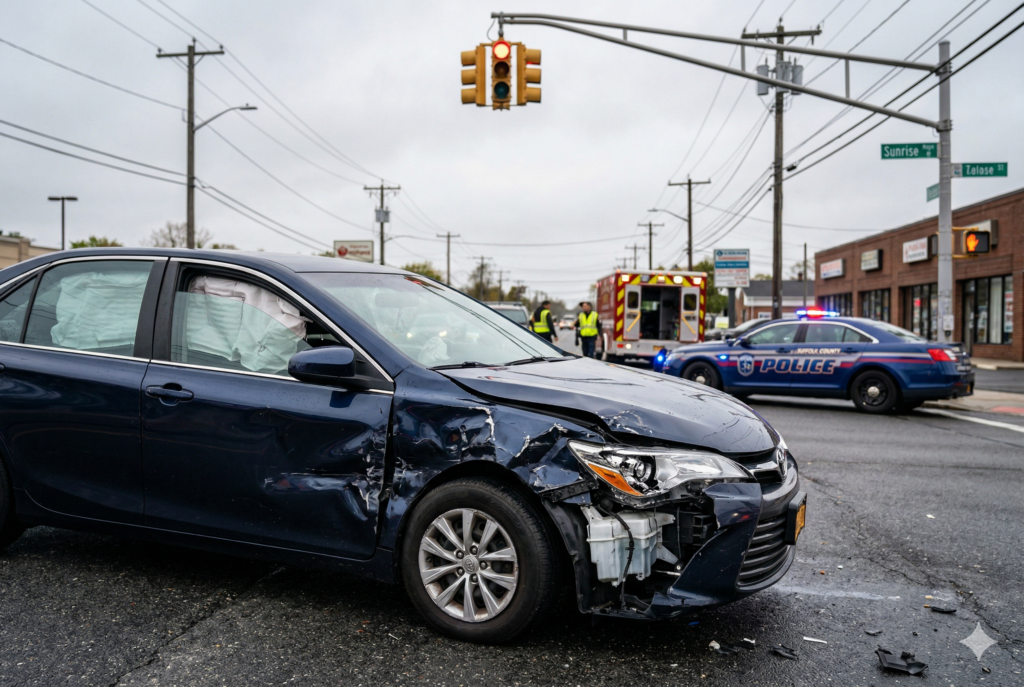
How New York's No-Fault System Works
New York operates under a no-fault auto insurance system established by Insurance Law § 5102(a). Every vehicle registered in the state must carry Personal Injury Protection (PIP) coverage, which pays benefits to the policyholder regardless of who caused the accident. This system is designed to provide quick payment for basic expenses without the delays of determining fault. PIP coverage provides up to $50,000 in benefits. This includes reasonable and necessary medical expenses for treatment received within one year of the accident, lost earnings up to $2,000 per month for a maximum of three years, and reimbursement for other reasonable expenses up to $25 per day for up to one year. You must file the application for no-fault benefits — the NF-2 form — within 30 days of the accident under Insurance Law § 5103. Missing this deadline can result in losing your right to these benefits entirely. However, the no-fault system has a significant limitation that many people do not understand until after an accident. PIP benefits do not cover pain and suffering. If you suffered a serious injury in a crash on Route 111 or anywhere else in Islip, no-fault insurance will help pay your medical bills and part of your lost wages, but it will not compensate you for the physical pain, emotional distress, and diminished quality of life caused by the accident. To recover those damages, you must pursue a separate claim against the at-fault driver — and you must first meet what New York law calls the "serious injury threshold."Meeting the Serious Injury Threshold
New York restricts lawsuits for pain and suffering after car accidents to cases involving a "serious injury" as defined by Insurance Law § 5102(d). This statute sets out nine specific categories. If your injury falls within at least one of them, you can step outside the no-fault system and file a lawsuit against the responsible driver. The nine categories are: death; dismemberment; significant disfigurement; fracture; loss of a fetus; permanent loss of use of a body organ, member, function, or system; permanent consequential limitation of use of a body organ or member; significant limitation of use of a body function or system; and a medically determined injury that prevents the person from performing substantially all of their usual daily activities for at least 90 of the first 180 days following the accident. Fractures automatically satisfy the threshold. For the "limitation" categories — which cover many soft tissue injuries like herniated discs, torn ligaments, and chronic pain conditions — you will need objective medical evidence to prove your case. This means MRI results, range-of-motion measurements, nerve conduction studies, and expert medical opinions documenting the extent and permanence of your limitations. Insurance companies routinely challenge threshold claims by sending injured people to their own defense medical examiners, whose reports often minimize injuries. Building a strong evidentiary record from your very first medical visit is essential to defeating these challenges.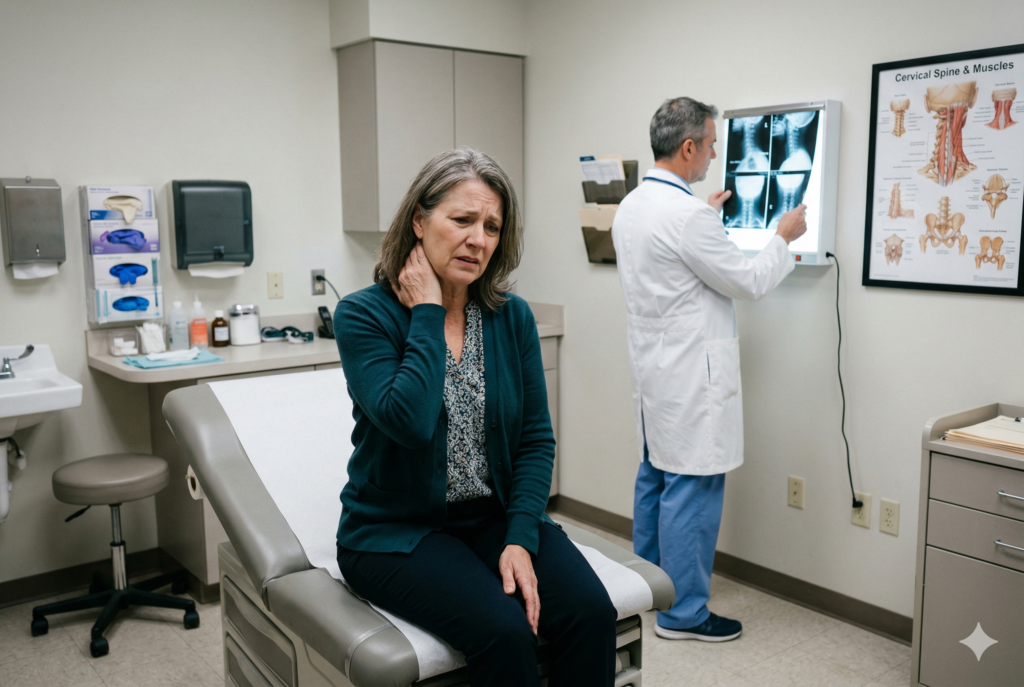
Injuries We See in Islip Car Accidents
The types of crashes that occur on Islip's roads — rear-end collisions at Route 111 signals, T-bone crashes at the Main Street intersection, high-speed impacts on Sunrise Highway — produce a range of serious injuries. The following are among the most common injuries our attorneys handle in car accident cases.Traumatic Brain Injuries
A blow to the head during a collision — from striking the steering wheel, window, or being jolted violently — can cause concussions, contusions, or diffuse axonal injuries. TBIs range from mild concussions that resolve in weeks to severe injuries causing permanent cognitive impairment. Even a "mild" TBI can qualify as a serious injury under the 90/180-day rule if it prevents you from performing your daily activities.Spinal Cord Injuries and Paralysis
High-speed impacts on Sunrise Highway or the Southern State Parkway can cause devastating spinal cord damage. Complete spinal cord injuries result in permanent paralysis below the injury site, while incomplete injuries may allow some sensation or movement. These injuries typically require lifelong medical care and adaptive equipment, generating damages that can reach into the millions of dollars.Herniated and Bulging Discs
The sudden deceleration forces in a collision can cause the discs between vertebrae to rupture or bulge, pressing against spinal nerves. Herniated discs commonly produce radiating pain, numbness, and weakness in the arms or legs depending on the location. When documented by MRI and supported by range-of-motion deficits, disc injuries often satisfy the "significant limitation" category of the serious injury threshold.Fractures and Broken Bones
Broken bones are common across all crash types, from wrist and arm fractures caused by bracing against the dashboard to hip and pelvic fractures from side-impact collisions. Under New York law, any fracture automatically satisfies the serious injury threshold, making it one of the most straightforward paths to pursuing a pain and suffering claim.Internal Organ Damage
Blunt force trauma to the abdomen or chest can cause internal bleeding, ruptured spleens, liver lacerations, or collapsed lungs. These injuries are medical emergencies that may not show obvious external signs at the scene. Delayed diagnosis of internal injuries is particularly dangerous, which is why seeking immediate medical evaluation after any significant collision is critical.Whiplash and Cervical Injuries
Rear-end collisions at traffic signals along Route 111 are a leading cause of whiplash, which occurs when the head snaps forward and backward violently. While sometimes dismissed as minor, whiplash can cause chronic neck pain, headaches, and limited range of motion that persists for months or years. Severe whiplash injuries with documented objective findings can meet the serious injury threshold.Knee, Shoulder, and Joint Injuries
The impact of a crash can tear ligaments, damage cartilage, and dislocate joints. ACL and meniscus tears in the knee, rotator cuff tears in the shoulder, and labrum injuries in the hip are common. Many of these injuries require surgical repair and months of rehabilitation, resulting in significant medical expenses and extended periods away from work.PTSD and Psychological Injuries
A serious car accident can cause lasting psychological harm, including post-traumatic stress disorder, driving anxiety, depression, and sleep disturbances. These conditions are recognized under New York law and may contribute to satisfying the serious injury threshold, particularly when they prevent you from returning to your normal daily activities during the first 180 days after the accident.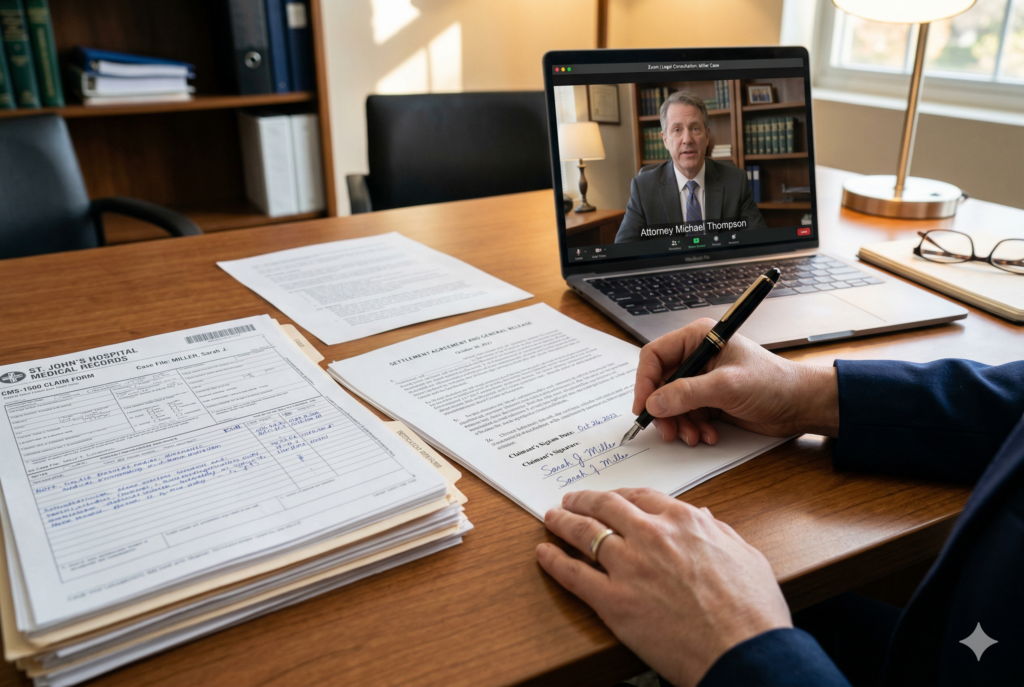
Identifying Who Is Liable
The at-fault driver. Most car accident claims are based on driver negligence. To establish liability, you must show that the other driver owed you a duty of care on the road, breached that duty through careless or reckless behavior, and that this breach caused the collision and your resulting injuries. Evidence such as the police accident report, witness statements, traffic camera footage, cell phone records showing distraction, and accident reconstruction analysis all help build the case against a negligent driver. An employer. When the at-fault driver was working at the time of the crash — whether driving a delivery truck, a company vehicle, or providing rideshare services — the employer may be held vicariously liable under the legal doctrine of respondeat superior. Commercial vehicle policies often carry coverage limits of $1 million or more, significantly exceeding standard personal auto policies. This applies to truck drivers, delivery drivers, construction workers in company vehicles, and employees running work errands. A vehicle or parts manufacturer. If a mechanical defect contributed to the crash — faulty brakes, defective tires, a malfunctioning airbag, a steering system failure — the manufacturer may be strictly liable for injuries caused by the defective product. Strict product liability does not require proving negligence. You must show the product was defective and that the defect caused your injuries. An accident reconstruction expert can help identify whether a vehicle defect played a role. A government entity. When dangerous road conditions contribute to an accident — potholes, missing signage, malfunctioning traffic signals, poor road design, inadequate lighting — the government entity responsible for maintaining that road may share liability. In Islip, this could be the Town of Islip for local roads, Suffolk County for county roads, or NYSDOT for state routes like Route 111. Claims against government entities require filing a Notice of Claim within 90 days under GML § 50-e, and the lawsuit must be filed within one year and 90 days under GML § 50-i. An alcohol vendor. New York's Dram Shop Act, codified in ABC Law § 65, allows injured victims to pursue claims against bars, restaurants, and liquor stores that served alcohol to a visibly intoxicated person who then caused a car accident. If you were struck by a drunk driver who had just left a bar or restaurant in Islip, the establishment may bear responsibility for over-serving that individual. A vehicle owner. Under New York's permissive use doctrine, the owner of a vehicle can be held liable when they allow someone else to drive their car and that person causes an accident. This means that even if the driver who hit you was borrowing someone else's vehicle, you may have a claim against the vehicle's owner.Injured in a Car Accident in Islip?
Alonso Krangle LLP serves Islip and communities throughout Suffolk County. Contact us for a free consultation. You pay nothing unless we recover compensation for you. Call 800-403-6191 for a Free Case Review
Common Accident Types and Comparative Fault
Islip's road network generates specific crash patterns tied to local conditions. Rear-end collisions are frequent at traffic signals along Route 111, particularly near the Sunrise Highway overpass where stop-and-go traffic catches drivers off guard. T-bone collisions occur at the Route 111 and Main Street intersection and at cross-streets where sight lines are limited by parked vehicles and commercial buildings. Head-on crashes sometimes happen on Main Street's narrower sections, and sideswipe accidents are common on Sunrise Highway during lane changes at highway speed. New York follows a pure comparative negligence rule under CPLR § 1411. This means that even if you were partially at fault for the accident, you can still recover damages. Your compensation is reduced by your percentage of fault, but it is never eliminated entirely. For example, if a jury awards $400,000 in damages but finds you were 20% at fault for the collision, your recovery would be $320,000. This is more favorable to injured victims than the 50% or 51% bar rules used in many other states, where being found more than half at fault would eliminate your recovery entirely.Steps to Protect Yourself After a Crash
- Call 911 and obtain a police report. An official accident report documents the scene, identifies witnesses, and records the responding officer's observations. This report becomes a foundational piece of evidence in any claim.
- Seek medical attention the same day. Even if you believe your injuries are minor, go to the emergency room or urgent care immediately. Some injuries — especially head trauma and internal bleeding — may not produce symptoms right away. Medical records created on the day of the accident establish a critical link between the crash and your injuries.
- Document the scene thoroughly. Take photographs of vehicle damage, the roadway, traffic signals, skid marks, debris, and your visible injuries. Capture the positions of all vehicles before they are moved. These photographs preserve evidence that may disappear within hours.
- File your NF-2 application within 30 days. Your no-fault benefits depend on timely filing. Request the NF-2 form from your auto insurer and submit it as soon as possible to secure your PIP coverage for medical bills and lost wages.
- Do not give a recorded statement to the other driver's insurer. The at-fault driver's insurance company may call you within days of the accident asking for a recorded statement. Anything you say can be used to minimize your claim. Politely decline and direct them to your attorney.
- Contact an attorney before accepting any settlement offer. Early settlement offers from insurance companies are almost always far below the true value of your claim. An experienced car accident lawyer can evaluate the full extent of your damages and negotiate from a position of knowledge.
Compensation Available to Accident Victims
Economic damages cover the measurable financial losses caused by the accident. This includes medical expenses beyond what PIP covers — surgeries, specialist visits, physical therapy, prescription medications, and future treatment needs. It also includes lost wages for time missed from work, diminished earning capacity if your injuries prevent you from returning to your previous occupation, and property damage to your vehicle and personal belongings. Non-economic damages compensate for losses that do not have a fixed dollar value but profoundly affect your life. Pain and suffering, emotional distress, loss of enjoyment of life, permanent disfigurement, and loss of consortium (the impact on your relationship with your spouse) are all recoverable in New York. Importantly, New York has no cap on non-economic damages in personal injury cases, meaning there is no artificial limit on what a jury can award for these losses. Punitive damages are awarded only in cases involving extreme misconduct — such as severe intoxication, street racing, or deliberately reckless behavior. While rare, they serve to punish the wrongdoer and deter similar conduct. In wrongful death cases, EPTL § 5-4.1 allows surviving family members to recover funeral and burial costs, lost financial support the deceased would have provided, and loss of parental guidance and companionship. If the at-fault driver's insurance policy is insufficient to cover your damages, your own uninsured/underinsured motorist (UM/UIM) coverage may provide additional compensation.Why Insurance Companies Fight Your Claim
Lowball early settlement offers. Within days of a serious accident, the at-fault driver's insurer may contact you with a settlement offer that seems generous when you are facing mounting bills. These early offers are calculated to close your claim before the full extent of your injuries is known. Once you accept, you waive your right to seek additional compensation — even if your condition worsens significantly. Recorded statement traps. Insurance adjusters are trained to ask questions designed to elicit statements that can be used against you. Questions like "Are you feeling better today?" or "Could you have done anything differently?" are designed to create ammunition for minimizing your claim or arguing comparative fault. Overbroad medical authorizations. Insurers may ask you to sign a blanket medical authorization giving them access to your entire medical history. They then comb through years of records looking for pre-existing conditions they can blame for your current symptoms, even when those conditions were asymptomatic before the accident. Treatment gap arguments. If there is any gap in your medical treatment — even a few weeks between appointments — the insurer will argue that your injuries must not have been that serious. Maintaining consistent medical care is important both for your recovery and for the strength of your legal claim. Defense medical examinations. Insurance companies have the right to require you to attend a so-called "independent" medical examination (IME). These exams are conducted by doctors selected and paid by the insurer, and the resulting reports frequently minimize injuries or claim that the injured person has fully recovered. Your attorney can help you prepare for these exams and challenge biased findings.
Key Fact: Studies consistently show that car accident victims represented by attorneys recover significantly higher settlements and verdicts than those who negotiate with insurance companies on their own. Insurance adjusters know this — and they know that an unrepresented claimant is far more likely to accept a lowball offer.
Filing Deadlines You Cannot Miss
| Action | Deadline | Authority |
|---|---|---|
| Notify insurer / file NF-2 | 30 days | Ins. Law § 5103 |
| Personal injury lawsuit | 3 years | CPLR § 214 |
| Wrongful death lawsuit | 2 years | EPTL § 5-4.1 |
| Notice of Claim (government entity) | 90 days | GML § 50-e |
| Lawsuit against government entity | 1 year + 90 days | GML § 50-i |
| UM/UIM claim | 6 years (contract) | CPLR § 213 |
Government Vehicle Deadline Warning
If your accident involved a Town of Islip vehicle, a Suffolk County vehicle, or a state highway condition on Route 111, you must file a Notice of Claim within just 90 days of the accident — far shorter than the standard 3-year personal injury statute of limitations. Missing this deadline can permanently bar your claim. Contact an attorney immediately after any accident involving a government entity.Frequently Asked Questions
I was hit at the Route 111 and Sunrise Highway interchange in Islip — who maintains that road?
Route 111 (Islip Avenue) is a state highway maintained by the New York State Department of Transportation (NYSDOT). Sunrise Highway (NY 27) is also a state route. If a road defect — such as the pothole damage documented along Route 111 — contributed to your crash, NYSDOT could share liability. Claims against state agencies require strict adherence to the 90-day Notice of Claim deadline. Local side streets in Islip are typically maintained by the Town of Islip.
Can I sue the other driver if I have no-fault insurance?
Yes, but only if your injury qualifies as a "serious injury" under Insurance Law § 5102(d). No-fault covers basic medical expenses and lost wages, but it does not cover pain and suffering. If your injury meets one of the nine threshold categories — such as a fracture, significant disfigurement, or permanent limitation — you can file a lawsuit against the at-fault driver for full compensation including pain and suffering.
What is the statute of limitations for a car accident lawsuit in New York?
You generally have three years from the date of the accident to file a personal injury lawsuit under CPLR § 214. Wrongful death claims must be filed within two years under EPTL § 5-4.1. However, if a government entity is involved, the Notice of Claim must be filed within 90 days, and the lawsuit within one year and 90 days. Starting early allows your attorney to preserve evidence and build the strongest possible case.
I was partially at fault for the accident — can I still recover compensation?
Yes. New York follows a pure comparative negligence rule under CPLR § 1411, meaning you can recover damages even if you were partly at fault. Your compensation is simply reduced by your percentage of fault. If you are found 35% responsible and the total damages are $500,000, you would still recover $325,000. There is no threshold at which you lose your right to recover entirely.
What compensation can I get for a car accident in New York?
If your injury meets the serious injury threshold, you can pursue economic damages (medical bills beyond PIP, lost wages, diminished earning capacity, property damage), non-economic damages (pain and suffering, emotional distress, loss of enjoyment of life, disfigurement), and in rare cases of extreme misconduct, punitive damages. New York places no cap on non-economic damages in car accident cases.
How much does it cost to hire a car accident lawyer at Alonso Krangle LLP?
There is no upfront cost. Alonso Krangle LLP handles car accident cases on a contingency fee basis, which means you pay nothing unless we recover compensation for you. Your initial consultation is completely free, and we advance all costs of investigating and pursuing your claim. You only pay a legal fee if we win your case.
What if the driver who hit me was texting or using their phone?
Distracted driving is a form of negligence that can strengthen your claim significantly. Cell phone records can be subpoenaed to show the at-fault driver was texting, browsing, or using an app at the time of the crash. New York law prohibits handheld phone use while driving, and a violation can serve as evidence of negligence per se — meaning the driver violated a safety statute designed to prevent exactly the type of harm that occurred.
My MRI shows a herniated disc — is that enough to meet the serious injury threshold?
An MRI showing a herniated disc is strong evidence, but standing alone it may not be sufficient. Insurance companies and courts typically require objective proof that the herniation causes a measurable limitation of use — such as documented range-of-motion deficits, neurological findings, or functional restrictions confirmed by a treating physician. Your attorney can work with your medical providers to ensure the necessary documentation is in place.
Should I post about my car accident on social media?
No. Insurance companies routinely monitor the social media accounts of claimants looking for photos, posts, or check-ins that can be used to argue your injuries are not as serious as claimed. A single photo of you smiling at a family event could be mischaracterized as evidence that you are not suffering. The safest approach is to avoid posting anything about your accident, injuries, or activities until your case is resolved.
Related Resources
Speak with An Attorney
Submit This Form or Call 800-403-6191