

Melville
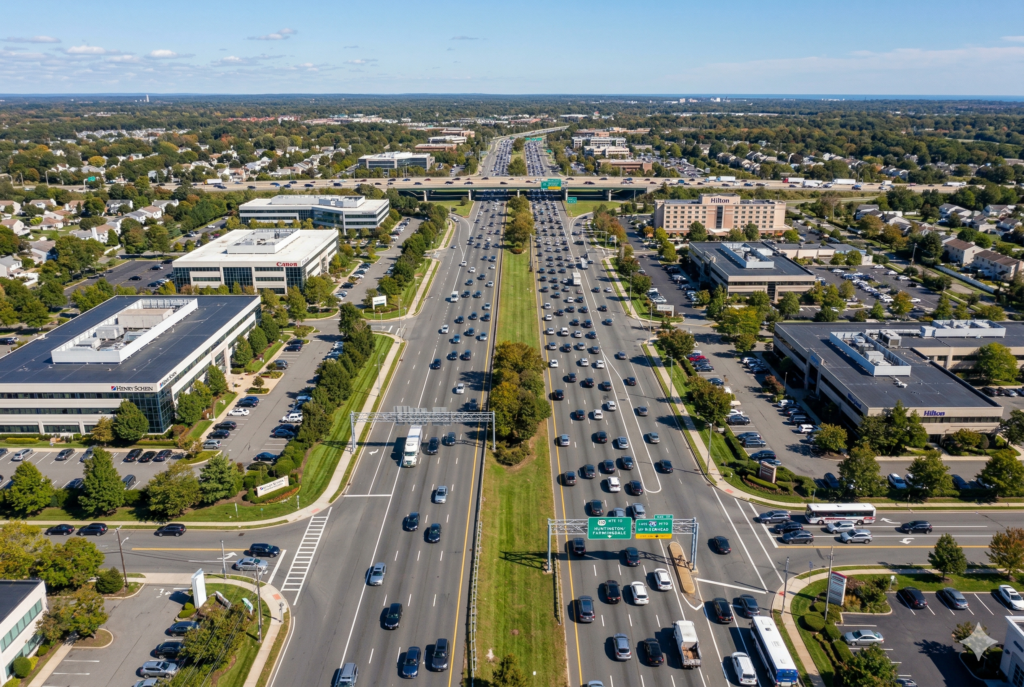
Melville is home to one of Long Island's most heavily trafficked corridors — Route 110 (Broadhollow Road) — where corporate campuses, industrial parks, and the Long Island Expressway interchange generate enormous volumes of commercial and commuter traffic every day. Fatal crashes, pedestrian strikes, and multi-vehicle pileups on this corridor are well documented. Alonso Krangle LLP is based in Melville and represents car accident victims throughout the community and across Long Island.
Why Melville's Roads Are Among the Most Dangerous on Long Island
Melville is a hamlet within the Town of Huntington in Suffolk County. Route 110 (Broadhollow Road) runs north-south through the community as a multi-lane divided highway, serving as the primary artery for one of Long Island's largest concentrations of corporate offices, industrial parks, and commercial centers. The Long Island Expressway (I-495) crosses through Melville with its interchange at Route 110 — one of the most crash-prone interchange areas in Suffolk County. Old Country Road, Ruland Road, Baylis Road, and the LIE service roads add further traffic complexity to the area. Route 110 through Melville has one of the highest fatal crash rates among Suffolk County's surface roads. Documented incidents include a fatal pedestrian strike on Broadhollow Road between Spagnoli Road and Ruland Road, a fatal rear-end collision with a stopped tractor-trailer at the Duryea Road intersection, and a fatal LIE crash near the Route 110 overpass that killed one person and seriously injured four others. The LIE merge zones near Route 110 are identified as particularly problematic for commercial vehicles due to short acceleration lanes and extreme speed differentials between trucks and passenger cars. The Melville Fire Department has publicly urged drivers to exercise "extra care" on area roads after responding to three serious crashes within five hours on a single day. Suffolk County recorded 164 traffic deaths in 2022 — the highest of any county in New York State. Across Long Island, traffic fatalities rose approximately 40% since 2019, with crashes becoming more severe even as total accident numbers declined. Nassau and Suffolk counties combined average 83 fatal or injury-causing accidents every day. One in three fatal crashes involve speeding, and one in three involve alcohol.
Local Context: Route 110 (Broadhollow Road) through Melville carries one of the highest concentrations of commercial and commuter traffic in Suffolk County, and its fatal crash rate is among the worst for any surface road in the county. The LIE interchange at Route 110 creates dangerous merge conditions, particularly for commercial trucks. Alonso Krangle LLP's office is located at 425 Broad Hollow Road, Suite 408 — directly on the Route 110 corridor — giving our attorneys firsthand familiarity with the roads and conditions that cause accidents in this community.
No-Fault Insurance: What You Receive and What You Don't
Every vehicle registered in New York must carry Personal Injury Protection (PIP) coverage under Insurance Law § 5102(a). When you are involved in an accident in Melville, your own insurer pays your PIP benefits regardless of fault. This system provides prompt financial support for basic expenses but has clear boundaries. PIP coverage provides a maximum of $50,000 allocated across medical expenses (treatment within one year of the accident), lost earnings ($2,000/month cap for up to three years), and incidental expenses ($25/day for one year). You must submit the NF-2 application to your insurer within 30 days under Insurance Law § 5103. This deadline is absolute. What PIP does not cover is often the most devastating consequence of a serious crash: pain and suffering. The victim of a fatal-speed rear-end collision on Route 110 who survives with permanent spinal damage receives PIP benefits for medical bills and partial lost wages — but nothing for the chronic pain that alters every day of their life, the emotional trauma that follows, or the career they can no longer pursue. To recover non-economic damages, you must meet New York's serious injury threshold and pursue a separate fault-based claim.The Legal Standard for Serious Injury
Under Insurance Law § 5102(d), New York restricts pain and suffering lawsuits to car accident victims whose injuries meet one of nine defined "serious injury" categories. This threshold balances the no-fault system's guarantee of PIP benefits against the right to pursue a full lawsuit for more significant injuries. The nine categories are: death; dismemberment; significant disfigurement; fracture; loss of a fetus; permanent loss of use of a body organ, member, function, or system; permanent consequential limitation of use of a body organ or member; significant limitation of use of a body function or system; and a medically determined injury preventing the victim from performing substantially all of their customary daily activities for at least 90 days within the first 180 days following the accident. Fractures automatically qualify — any diagnosed broken bone satisfies the threshold. The "limitation" categories require extensive documentation: MRI or CT imaging confirming the anatomical injury, range-of-motion testing showing quantified functional deficits, neurological studies, and expert medical opinions establishing the injury's connection to the accident and its permanent or significant nature. Insurers aggressively contest these claims with defense medical examiners. Building a thorough medical evidence record from the first treatment visit is what separates successful claims from those that fail at the threshold.
Injuries Commonly Caused by Melville Crashes
Melville's accident dynamics — high-speed commercial vehicle rear-end crashes on Route 110, pedestrian strikes in corporate park zones, multi-vehicle pileups on the LIE at the Route 110 interchange — produce the full spectrum of serious injuries.Spinal Cord Injuries and Paralysis
The high-speed, high-mass collisions that occur on Route 110 and the LIE can cause catastrophic spinal cord damage resulting in permanent paraplegia or quadriplegia. These injuries require emergency surgical intervention, months in intensive care, and lifelong medical management. Lifetime costs including medical care, home modifications, personal assistance, and adaptive equipment routinely reach several million dollars.Traumatic Brain Injuries
Pedestrians struck by vehicles on Broadhollow Road and occupants of vehicles involved in LIE crashes are especially vulnerable to traumatic brain injuries. TBIs range from concussions producing headaches and short-term cognitive difficulties to severe injuries causing permanent personality changes, memory loss, and an inability to work. Early diagnosis through neuroimaging and neuropsychological testing is essential for both treatment and legal documentation.Fractures and Broken Bones
Multi-vehicle crashes on the LIE and T-bone collisions at Route 110 intersections produce fractures of the ribs, pelvis, hips, legs, wrists, and facial bones. Complex fractures requiring surgical fixation with plates, screws, or rods may necessitate multiple operations and extended rehabilitation. Every fracture automatically meets the serious injury threshold under New York law.Herniated and Bulging Discs
The deceleration forces in rear-end crashes — which are extremely common along Route 110's congested corridor — compress and rupture spinal discs. Herniated discs press against nerves, causing chronic back pain, sciatica, numbness, and muscle weakness. These injuries can require epidural injections, physical therapy, or fusion surgery. When properly documented with MRI findings and functional limitation testing, they frequently meet the threshold.Crush Injuries and Amputation
Collisions involving commercial trucks, tractor-trailers, and heavy vehicles — common on the Route 110 corridor and the LIE — can trap vehicle occupants and crush limbs beyond surgical repair. Traumatic amputations or post-accident surgical amputations require prosthetics, extensive rehabilitation, and permanent adaptive care. These injuries qualify under multiple serious injury categories including dismemberment.Internal Organ Damage
Blunt force trauma from steering wheel impacts, seatbelt compression, and vehicle intrusion can cause liver lacerations, splenic rupture, kidney contusions, and pneumothorax. Pedestrians struck by vehicles are particularly vulnerable to internal injuries. These conditions may not produce visible external signs, making immediate emergency evaluation critical after any significant collision on Melville's roads.Torn Ligaments and Joint Injuries
ACL, MCL, and meniscus tears in the knee, rotator cuff injuries in the shoulder, and labral tears result from the sudden forces transmitted through the body during a collision. These injuries typically require arthroscopic surgery and months of physical therapy. The extended recovery generates substantial medical bills and lost income.Burns and Disfigurement
Post-collision vehicle fires, contact with hot engine or exhaust components, and chemical burns from airbag deployment chemicals can produce serious burn injuries. Facial lacerations from shattered glass and deep abrasions from seatbelt friction cause lasting scars. Significant disfigurement is its own independent category of serious injury under New York law.
Identifying All Liable Parties
The at-fault driver. A driver who rear-ends a stopped vehicle at the Duryea Road intersection on Route 110, runs a red light at Baylis Road, or causes a chain-reaction crash on the LIE service road can be held liable through a negligence claim. Evidence including police reports, dashcam and surveillance footage from nearby corporate parks, cell phone records, and accident reconstruction analysis establish the driver's breach of duty. An employer. Melville's corporate and industrial parks generate enormous commercial vehicle traffic. When a truck driver, delivery worker, or any employee causes a crash during work duties, the employer may be vicariously liable under respondeat superior. Commercial insurance policies typically carry $1 million or more in coverage — critical in cases involving catastrophic injuries where personal auto policy limits are insufficient. Vehicle or parts manufacturers. Defective components — brakes, tires, airbags, steering systems, vehicle structural integrity — that cause or worsen a crash give rise to strict product liability claims against the manufacturer. No proof of negligence is required; you must show only that the product was defective and caused your injuries. Government entities. The Town of Huntington maintains local Melville roads. Route 110 and the LIE are maintained by NYSDOT. When dangerous conditions — potholes, broken signals, faded lane markings, inadequate lighting, poor interchange design — contribute to a crash, the responsible entity may share liability. All government claims require a Notice of Claim within 90 days under GML § 50-e and a lawsuit within one year and 90 days under GML § 50-i. Alcohol vendors. Under ABC Law § 65, bars and restaurants that serve alcohol to visibly intoxicated patrons who then cause drunk driving accidents may be held liable for the resulting injuries. Vehicle owners. New York's permissive use doctrine holds vehicle owners liable when the driver they allowed to use the vehicle causes an accident, providing an additional source of insurance coverage.Injured in a Car Accident in Melville?
Alonso Krangle LLP is based in Melville at 425 Broad Hollow Road, Suite 408. We know these roads because we drive them every day. Contact us for a free consultation — you pay nothing unless we win. Call 800-403-6191 — We're Right Down the Road
Crash Dynamics in Melville and Comparative Fault
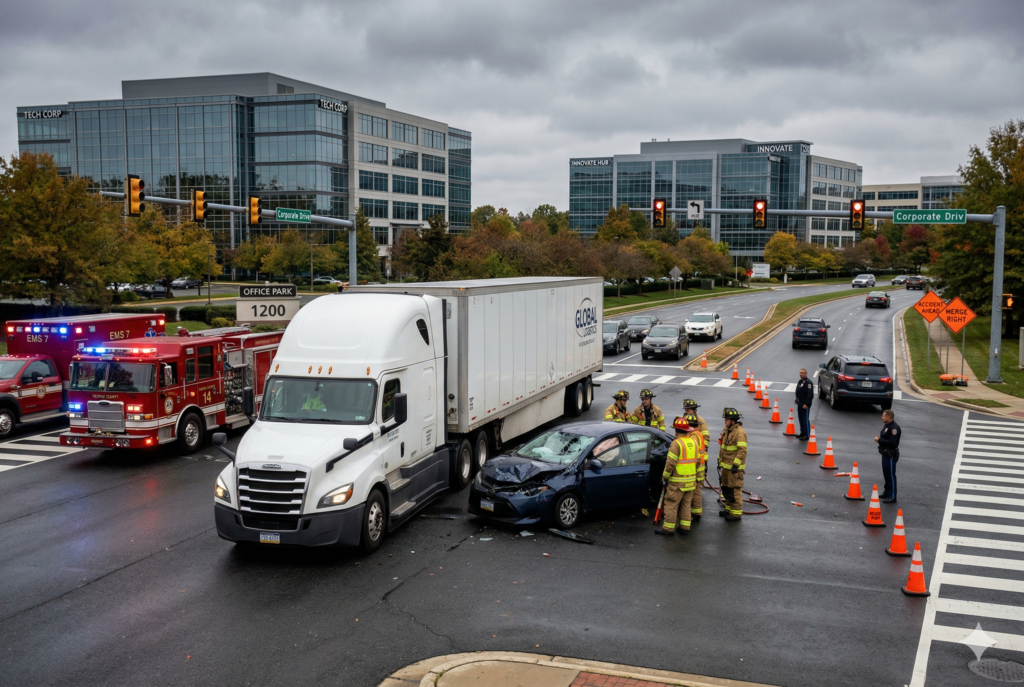
Melville's crash patterns are shaped by Route 110's function as both a high-speed commuter corridor and a commercial access road. Rear-end collisions are the dominant crash type along Broadhollow Road, often involving commercial trucks rear-ending stopped vehicles at intersections. Multi-vehicle pileups occur on the LIE at the Route 110 interchange, particularly during rush hour. Pedestrian accidents happen near corporate campus entrances and along Broadhollow Road where workers walk between office buildings and parking facilities. Sideswipe accidents result from lane changes on Route 110's multi-lane sections, and T-bone crashes occur at intersections with Ruland Road, Baylis Road, and the LIE service roads. Under CPLR § 1411, New York uses pure comparative negligence. Your recovery is reduced by your percentage of fault but is never barred entirely. If damages total $700,000 and you are found 10% at fault for not reducing your speed in a construction zone, you would recover $630,000. This is significantly more favorable than states that eliminate recovery once fault exceeds 50% or 51%.Your Post-Accident Action Plan
- Call 911 immediately. A police report is essential evidence. On Route 110 and the LIE, New York State Police and Suffolk County Police respond to crashes — ensure a report is filed documenting all vehicles, drivers, and witnesses.
- Seek emergency medical care the same day. Go to the nearest emergency room. Many life-threatening injuries — internal bleeding, TBIs, spinal cord compression — do not present immediate symptoms. Same-day medical records are critical evidence linking your injuries to the crash.
- Document everything at the scene. Photograph all vehicle damage, road conditions, traffic signals, skid marks, and your injuries. Melville's corporate corridor has extensive surveillance cameras — note any nearby cameras that may have captured the accident.
- File your NF-2 within 30 days. This deadline is absolute. Contact your auto insurer and submit the completed form promptly to secure your PIP benefits.
- Decline recorded statements from the opposing insurer. You are not required to provide a recorded statement. Everything you say can be used to minimize your claim.
- Consult a car accident attorney before accepting any offer. Early offers are designed to close claims cheaply. An experienced attorney evaluates the full value of your case — including future medical needs, lifetime earning impacts, and pain and suffering — before advising on any settlement.
Calculating the Full Value of Your Claim
Economic damages cover every quantifiable financial loss: medical expenses beyond PIP (surgeries, ICU stays, imaging, rehabilitation, future treatment), lost wages and benefits, diminished earning capacity, property damage, and in catastrophic cases, the cost of home modifications, adaptive equipment, and in-home care. Non-economic damages address the suffering that no financial formula fully captures. Physical pain and suffering, emotional distress, loss of enjoyment of life, permanent scarring and disfigurement, and the impact on your marital relationship (loss of consortium) are all compensable. New York has no cap on non-economic damages in car accident cases — recovery is determined by the specific facts of your case and the jury's assessment of your losses. Punitive damages are available in rare cases involving extreme misconduct — severely intoxicated driving, street racing, or intentional recklessness. They punish and deter rather than compensate. In wrongful death cases, EPTL § 5-4.1 allows recovery of funeral costs, lost financial support, and loss of companionship. UM/UIM coverage supplements recovery when the at-fault driver's insurance is insufficient.Defense Strategies Used by Insurance Companies
Rushing to settle before your treatment is complete. Insurers contact crash victims within days with settlement offers calculated to close claims before the full extent of injuries becomes apparent. These offers are almost always far below the true value of the case. Accepting permanently waives your right to seek additional compensation. Recording your statements for use against you. Adjusters are trained to ask questions designed to elicit admissions of partial fault, symptom minimization, and inconsistencies. A recorded statement is a deposition without a lawyer — and the insurer controls the transcript. Demanding unrestricted medical record access. Blanket medical authorizations let insurers comb through decades of your health records looking for any pre-existing condition to blame for your current symptoms. Targeting gaps in your treatment. Missing physical therapy sessions or delaying follow-ups gives the insurer documented ammunition to argue your injuries are not serious enough to warrant the compensation you are seeking. Deploying defense medical examiners. Insurers schedule "independent" exams with doctors who regularly minimize injuries on their behalf. Your attorney can prepare you for these exams and retain independent medical experts to counter biased findings. Dispatching rapid response teams in truck cases. When a commercial vehicle is involved, the carrier's insurer may deploy investigators to the scene within hours to secure evidence favorable to the defense — before you have legal representation. Having an attorney involved immediately protects your interests.
Key Fact: Accident victims with legal representation consistently recover higher compensation than those who negotiate alone. At Alonso Krangle LLP, our Melville office allows us to investigate local crashes quickly, securing surveillance footage and witness statements before evidence is lost.
Filing Deadlines That Cannot Be Extended
| Action | Deadline | Authority |
|---|---|---|
| Notify insurer / file NF-2 | 30 days | Ins. Law § 5103 |
| Personal injury lawsuit | 3 years | CPLR § 214 |
| Wrongful death lawsuit | 2 years | EPTL § 5-4.1 |
| Notice of Claim (government entity) | 90 days | GML § 50-e |
| Lawsuit against government entity | 1 year + 90 days | GML § 50-i |
| UM/UIM claim | 6 years (contract) | CPLR § 213 |
Government Vehicle Deadline Warning
If your accident involved a Town of Huntington vehicle, Suffolk County equipment, or a hazardous condition on Route 110 or the LIE maintained by NYSDOT, you must file a Notice of Claim within 90 days. This deadline is one of the shortest in New York personal injury law. Missing it almost always permanently bars your claim.Frequently Asked Questions
I was rear-ended by a truck on Route 110 near the LIE interchange in Melville — what should I do?
Call 911 immediately and get medical attention the same day — commercial truck collisions generate enormous forces that often produce internal injuries and spinal damage not immediately apparent. Do not speak with the trucking company's insurer or investigators. Large carriers often dispatch rapid response teams to accident scenes within hours to gather evidence favorable to their defense. Contact Alonso Krangle LLP — our office is located directly on Route 110 in Melville, and we can begin investigating your case immediately.
What makes a car accident injury "serious" under New York law?
Insurance Law § 5102(d) defines nine categories: death, dismemberment, significant disfigurement, fracture, loss of a fetus, permanent loss of use, permanent consequential limitation, significant limitation, and a medically determined injury preventing substantially all daily activities for 90 of 180 days. Fractures auto-qualify. Other injuries require objective medical documentation.
What deadlines apply to my car accident claim?
NF-2 for no-fault: 30 days. Personal injury lawsuit: 3 years (CPLR § 214). Wrongful death: 2 years (EPTL § 5-4.1). Government entity Notice of Claim: 90 days (GML § 50-e). Government lawsuit: 1 year + 90 days (GML § 50-i). UM/UIM: 6 years (CPLR § 213).
I was walking to my office on Route 110 and was hit by a car — what are my rights?
Pedestrians struck by vehicles can pursue claims for all damages — medical bills, lost wages, pain and suffering — without meeting the serious injury threshold that applies to vehicle occupants. Route 110's high-speed traffic and limited pedestrian infrastructure make it particularly hazardous for people on foot. Your right to recover is protected even if you share some fault for the accident under New York's comparative negligence rule.
Can I recover compensation if I was partly at fault?
Yes. Under CPLR § 1411, New York uses pure comparative negligence — your recovery is reduced by your percentage of fault but is never eliminated. You can recover even if you were more at fault than the other driver.
How much does it cost to hire Alonso Krangle LLP?
Nothing upfront and nothing unless we win. We handle car accident cases on a contingency fee basis, meaning you pay no attorney's fees or costs unless we recover compensation for you. The initial consultation is free.
What evidence should I preserve after a truck accident on Route 110?
Beyond standard evidence (photos, police report, medical records), truck cases require preserving the driver's hours-of-service logs, electronic data recorder (black box) data, the carrier's vehicle maintenance records, driver training files, and dispatch records. Federal regulations only require carriers to retain some records for limited periods. Your attorney should send a preservation letter to the trucking company immediately to prevent destruction of this evidence.
What if the LIE merge zone design contributed to my crash?
If the road design — including short acceleration lanes, inadequate signage, or poor visibility — contributed to the collision, NYSDOT may share liability. Government claims require a Notice of Claim within 90 days, so time is critical. Your attorney can retain traffic engineering experts to evaluate whether the interchange design met applicable safety standards.
Should I post about my car accident on social media?
No. Insurance companies actively monitor claimants' social media accounts for posts, photos, and check-ins they can use to argue your injuries are not as severe as claimed. Even an innocent photo at a family gathering can be mischaracterized. The safest approach is to avoid posting anything about your accident, injuries, or daily activities until your case is fully resolved.
Related Resources
Speak with An Attorney
Submit This Form or Call 800-403-6191