

Deer Park
Deer Park is bisected by some of Suffolk County's most heavily trafficked corridors, including Route 231 (Deer Park Avenue), Commack Road, and the Long Island Expressway. These high-volume roads generate a steady stream of serious collisions that leave drivers and passengers facing life-altering injuries. Alonso Krangle LLP represents Deer Park accident victims throughout the legal process, from the initial insurance claim through trial if necessary, to secure the full compensation they deserve.

Why Deer Park Roads Are Dangerous
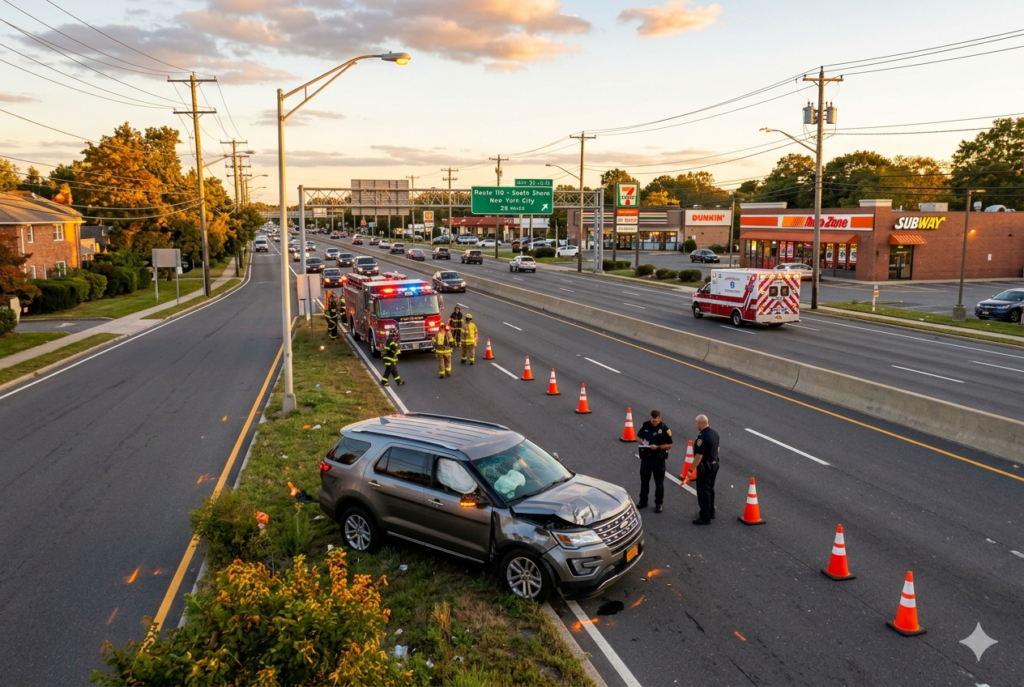
Deer Park is a hamlet in the Town of Babylon in Suffolk County, bordered by Dix Hills to the north, North Babylon to the south, Brentwood to the east, and Wyandanch to the west. Route 231 (Deer Park Avenue) runs north-south through the community as a four-lane divided highway, carrying a mix of commuter traffic, commercial vehicles, and local drivers between the Southern State Parkway and the Northern State Parkway. Commack Road (County Road 4) branches off Deer Park Avenue and feeds traffic eastward toward Brentwood and the LIE, while the Long Island Expressway itself passes through the northern reaches of the community with exits that funnel vehicles onto local roads. The intersection of Deer Park Avenue and Commack Road is one of the most collision-prone crossings in the area. Drivers traveling at highway speed along Route 231 encounter traffic signals where the road transitions from expressway-style driving to surface-street conditions. The LIE merge zones near Route 231 are documented trouble spots for commercial vehicles — short acceleration lanes force trucks to merge into 65-mph traffic without adequate space, producing rear-end collisions and sideswipe crashes. South of the LIE, Deer Park Avenue passes under the LIRR Main Line and continues through a commercial corridor where frequent left turns, delivery vehicles blocking lanes, and pedestrians crossing between businesses create constant hazards. Suffolk County recorded 164 traffic fatalities in 2022, the highest of any county in New York State. Traffic deaths across Long Island increased roughly 40% since 2019, and experts note that crashes are becoming more severe even as total accident numbers and miles driven have declined. With speeding contributing to one in three fatal crashes and alcohol involved in another third, Deer Park's high-speed corridors present serious risks to everyone sharing the road.
High-Risk Corridor: Route 231 (Deer Park Avenue) connects the Southern State Parkway to the Northern State Parkway through Deer Park, functioning as a de facto expressway through a commercial area. The LIE interchange at Route 231 has been identified as particularly problematic for commercial vehicles due to short merge lanes and high speed differentials between trucks and passenger cars. Wrong-way crashes have also been documented on the Route 231 corridor.
Understanding Your No-Fault Benefits
Every car accident victim in New York is entitled to Personal Injury Protection (PIP) benefits through their own auto insurance policy under Insurance Law § 5102(a). The no-fault system pays these benefits regardless of who caused the crash, providing a baseline of financial support while fault is determined. PIP covers up to $50,000 in total benefits, broken down into three categories. Medical expenses — including emergency room visits, diagnostic imaging, surgery, specialist care, and physical therapy — must be incurred within one year of the accident to qualify. Lost earnings benefits pay up to $2,000 per month for a maximum of three years if your injuries prevent you from working. A modest daily allowance of $25 covers other out-of-pocket costs for up to one year. To access these benefits, you must file the NF-2 application with your own auto insurer within 30 days of the collision, as mandated by Insurance Law § 5103. The critical gap in the no-fault system is that PIP does not cover pain and suffering, emotional distress, or any other non-economic losses. A person who suffers a herniated disc in a crash on Deer Park Avenue may receive $50,000 in PIP benefits for treatment and lost wages — but those benefits say nothing about the chronic pain that keeps them awake at night, the activities they can no longer enjoy, or the strain on their family. Recovering compensation for those losses requires meeting New York's serious injury threshold and pursuing a separate claim against the at-fault driver.The Serious Injury Requirement in New York
Before you can sue an at-fault driver for pain and suffering in New York, you must demonstrate that your injuries qualify as "serious" under Insurance Law § 5102(d). This legal gatekeeping mechanism prevents lawsuits for minor injuries but allows full legal recourse for people who have been genuinely harmed. The statute lists nine qualifying categories: death; dismemberment; significant disfigurement; fracture; loss of a fetus; permanent loss of use of a body organ, member, function, or system; permanent consequential limitation of use of a body organ or member; significant limitation of use of a body function or system; and a medically determined injury that prevents the victim from performing substantially all of their usual daily activities for not less than 90 days during the 180 days immediately following the accident. Any fracture — from a hairline crack in the wrist to a compound fracture of the femur — automatically meets the threshold. The limitation categories require more extensive proof. For a herniated disc to qualify under the "significant limitation" or "permanent consequential limitation" category, you generally need MRI or CT imaging confirming the herniation, documented range-of-motion restrictions compared to normal values, ongoing treatment records showing the condition's impact over time, and medical expert opinions connecting the injury to the accident. Insurance companies systematically challenge these claims through defense medical examiners who are paid to minimize findings. Building your medical evidence record carefully from the day of the accident is the single most important thing you can do to protect your claim.
Injuries Caused by Deer Park Collisions
The crash dynamics along Deer Park's corridors — high-speed rear-end collisions on Route 231, broadside impacts at Commack Road, LIE merge accidents involving commercial trucks — produce injuries ranging from painful soft tissue damage to catastrophic, life-threatening trauma.Spinal Cord Injuries and Paralysis
High-speed collisions on Route 231 and the LIE can cause catastrophic spinal cord damage leading to paraplegia or quadriplegia. These injuries typically require emergency surgery, extended ICU stays, and lifelong medical care including wheelchairs, home modifications, and around-the-clock assistance. The economic and non-economic damages in spinal cord injury cases routinely reach millions of dollars.Traumatic Brain Injuries
Head trauma ranges from mild concussions that temporarily impair concentration and memory to severe TBIs that permanently alter cognitive function, personality, and the ability to live independently. Even with seatbelts and airbags, the force of a collision on a corridor like Deer Park Avenue can cause the brain to impact the inside of the skull, producing bruising, bleeding, and axonal damage.Fractures and Broken Bones
Broken ribs, fractured collarbones, wrist and forearm fractures, and broken legs are among the most common injuries in Deer Park car accidents. Multi-vehicle crashes on the LIE can produce crush injuries with multiple fractures requiring surgical repair with plates, screws, or rods. Any fracture automatically qualifies as a serious injury under New York law.Herniated and Bulging Discs
Disc injuries are especially common in rear-end collisions along Route 231's commercial corridor where stop-and-go traffic leads to sudden impacts. When a disc herniates, the inner material pushes against spinal nerves, causing pain, numbness, and weakness in the extremities. Untreated, these injuries can lead to chronic pain and disability requiring epidural injections or spinal fusion surgery.Crush Injuries and Amputation
Collisions involving commercial trucks on the LIE or Route 231 can trap victims inside their vehicles, crushing limbs, hands, or feet. Severe crush injuries may require amputation when tissue damage is too extensive for surgical repair. Amputation cases involve prosthetics, rehabilitation, and lifelong adaptive needs that produce substantial economic and non-economic damages.Knee, Shoulder, and Joint Injuries
Dashboard impacts commonly damage the knee — tearing the ACL, MCL, or meniscus. Shoulder injuries including rotator cuff tears occur when a driver braces against the steering wheel during impact. These injuries frequently require arthroscopic surgery, followed by extended rehabilitation programs that can keep victims out of work for months.PTSD and Psychological Injuries
Survivors of violent crashes — particularly those involving rollovers, fires, or witnessing a passenger's serious injuries — may develop PTSD, severe driving anxiety, depression, or panic disorders. New York courts recognize psychological injuries as compensable, especially when documented through psychiatric or psychological treatment records and when they prevent the victim from maintaining their normal routines.Who Can Be Held Responsible
The driver who caused the crash. Whether the collision resulted from speeding on Route 231, running a red light at Commack Road, tailgating on the LIE, or texting behind the wheel, a negligent driver bears primary responsibility. Proving negligence means establishing that the driver failed to exercise reasonable care and that this failure directly caused the accident and your injuries. Evidence including police reports, dashcam video, cell phone usage records, and eyewitness testimony supports these claims. The driver's employer. Deer Park's proximity to the LIE and major industrial parks means commercial vehicles are a regular presence on local roads. When a truck driver, delivery worker, or any employee causes an accident during work duties, the employer can be held vicariously liable. Employer liability opens access to commercial insurance policies that typically carry limits of $1 million or more — far beyond standard personal coverage. Product manufacturers. Defective vehicle components — brake failures, tire blowouts, airbag malfunctions, seat structure collapses — can cause or worsen crashes. Manufacturers face strict liability for defective products, meaning you do not need to prove they were careless, only that the product was defective and caused your harm. Expert analysis of the vehicle wreckage can identify defects that may not be obvious at the scene. Government entities. The Town of Babylon maintains local Deer Park roads. Suffolk County is responsible for county roads like Commack Road. NYSDOT maintains Route 231 and the LIE. When poor road conditions, missing signs, broken signals, or dangerous road designs contribute to a crash, the responsible government agency may share liability. These claims require a Notice of Claim filed within 90 days under GML § 50-e and a lawsuit within one year and 90 days under GML § 50-i. Alcohol vendors. Under the Dram Shop Act (ABC Law § 65), an establishment that serves alcohol to someone who is visibly intoxicated — and that person subsequently causes a car accident — may be held liable for the resulting injuries. This creates an additional source of recovery beyond the drunk driver's own insurance. Vehicle owners. Under New York law, the registered owner of a vehicle may be held liable when they allow another person to use their car and that person causes an accident. This permissive use doctrine means you may have a claim against the vehicle owner even if the driver had inadequate insurance coverage.Injured in a Car Accident in Deer Park?
Alonso Krangle LLP represents car accident victims in Deer Park and throughout Suffolk County. Our consultations are always free, and you pay no fees unless we win your case. Get Your Free Case Evaluation — 800-403-6191
Local Crash Patterns and Comparative Negligence
Deer Park's crash profile reflects its role as a transit corridor. High-speed rear-end collisions are common along Route 231 when drivers traveling at near-highway speeds encounter sudden traffic backups at signals. T-bone and angle collisions occur at the Deer Park Avenue and Commack Road intersection and at the Long Island Avenue crossing. Multi-vehicle pileups develop on the LIE during rush hour and in reduced-visibility conditions. Pedestrian accidents are a concern along the commercial strips of Deer Park Avenue, especially near the LIRR station where commuters cross busy lanes. New York's pure comparative negligence statute, CPLR § 1411, allows you to recover damages even if you bore some responsibility for the accident. Your award is reduced proportionally to your share of fault, but it is never eliminated. For instance, if the total damages in your case are $600,000 and a jury determines you were 15% at fault for failing to signal a lane change, your recovery would be $510,000. New York's approach is significantly more favorable to injured parties than the modified comparative negligence rules used in many other states, where crossing the 50% or 51% fault threshold would bar recovery entirely.Protecting Your Rights After an Accident
- Call 911 for police response. A police accident report establishes the facts of the collision and becomes a key piece of evidence. Ensure the responding officer documents all vehicles, drivers, witnesses, and road conditions.
- Get a medical evaluation immediately. Visit the emergency room or an urgent care center the same day as the accident. Many serious injuries — internal bleeding, traumatic brain injuries, disc herniations — do not produce immediate symptoms. Early diagnosis protects both your health and your legal claim.
- Preserve evidence from the scene. Photograph damage to all vehicles, the road surface, traffic controls, weather conditions, and any visible injuries. If there are witnesses, collect their names and phone numbers. Request any available surveillance or dashcam footage from nearby businesses.
- Submit your NF-2 form within 30 days. Contact your auto insurance company promptly to file for no-fault benefits. This 30-day deadline is absolute — failing to meet it can result in complete forfeiture of your PIP benefits, regardless of how severe your injuries are.
- Do not provide a recorded statement to the opposing insurer. The at-fault driver's insurance company will call you, often within 48 hours. Their goal is to capture statements they can use to limit or deny your claim. You are under no obligation to speak with them without an attorney present.
- Consult a car accident attorney before accepting any offer. Initial settlement offers are designed to close your case cheaply. An attorney evaluates the full scope of your damages — including future medical needs and long-term earning impacts — before advising you on whether an offer is fair.
What Your Claim May Be Worth
Economic damages represent the financial toll of the accident. Medical expenses that exceed your PIP coverage, including surgeries, hospitalizations, rehabilitation, assistive devices, and projected future care, form the core of economic damages. Lost wages for time away from work, reduced earning capacity if you cannot return to your previous job, and repair or replacement costs for your vehicle are also included. Non-economic damages address the physical and emotional suffering the accident has caused. Pain and suffering, emotional distress, loss of enjoyment of life, scarring and disfigurement, and loss of consortium are all compensable. New York imposes no cap on non-economic damages in personal injury cases. This means that the compensation for a victim's pain and suffering is determined by the specific facts of the case — the severity and permanence of the injury, the impact on daily life, and the degree to which the injury diminishes the person's quality of life. Punitive damages may be available in limited circumstances involving outrageous misconduct. A driver who caused a crash while severely intoxicated, engaged in street racing, or fled the scene may face punitive liability. These damages are intended to punish and deter, not to compensate. If the accident was fatal, the wrongful death statute (EPTL § 5-4.1) permits the estate to recover funeral expenses, lost financial support, and compensation for the family's loss of companionship and guidance. When the at-fault driver's insurance coverage is inadequate, uninsured/underinsured motorist (UM/UIM) coverage on your own policy may provide supplemental recovery.
Tactics Insurance Companies Use Against You
Pressuring you with early lowball offers. The other driver's insurer often contacts injured people within the first week or two with a check that covers initial medical bills but ignores future treatment, lost earning capacity, and pain and suffering. Accepting this offer permanently waives your right to seek additional compensation — even if your injuries turn out to be far worse than initially believed. Weaponizing your own words. Adjusters conducting recorded interviews are looking for inconsistencies, admissions of partial fault, and minimizing language ("I'm feeling a little better") they can quote in their files. Everything you say in a recorded statement becomes part of the permanent claim record. Demanding unrestricted medical record access. When an insurer asks you to sign a broad HIPAA authorization, they are seeking permission to review every medical record you have ever generated — not just those related to the accident. They hunt for prior complaints of back pain, shoulder problems, or anxiety that they can attribute your current symptoms to, even if those conditions were dormant or resolved before the crash. Pointing to treatment gaps as proof your injuries aren't serious. A two-week break in physical therapy, a missed specialist appointment, or any period without documented medical care becomes evidence — in the insurer's view — that your injuries are not significant enough to warrant the compensation you are seeking. Using defense medical examiners to contradict your doctors. The insurer may require you to attend an examination by a physician they select. These so-called independent examiners frequently produce reports stating that injuries have resolved, that the victim can return to work, or that the accident did not cause the claimed conditions. Your attorney can prepare you for these exams and engage independent medical experts to provide countering opinions.
Key Fact: Insurance companies employ entire departments dedicated to minimizing claim payouts. Accident victims who are represented by experienced attorneys consistently recover significantly more in settlements and verdicts than those who attempt to negotiate with insurers on their own.
Deadlines That Can Make or Break Your Case
| Action | Deadline | Authority |
|---|---|---|
| Notify insurer / file NF-2 | 30 days | Ins. Law § 5103 |
| Personal injury lawsuit | 3 years | CPLR § 214 |
| Wrongful death lawsuit | 2 years | EPTL § 5-4.1 |
| Notice of Claim (government entity) | 90 days | GML § 50-e |
| Lawsuit against government entity | 1 year + 90 days | GML § 50-i |
| UM/UIM claim | 6 years (contract) | CPLR § 213 |
90-Day Government Claim Warning
If your accident involved a Town of Babylon vehicle, Suffolk County road maintenance equipment, or a hazardous condition on a road maintained by the town, county, or state (including Route 231), you must file a Notice of Claim within 90 days of the accident. This is one of the shortest deadlines in New York personal injury law and missing it is virtually always fatal to your claim. Speak with an attorney immediately.Frequently Asked Questions
I was rear-ended on Route 231 near Commack Road in Deer Park — what should I do?
First, call 911 and get a police report documenting the crash. Seek medical attention the same day, even if your pain seems manageable — rear-end collisions on high-speed roads like Route 231 often cause disc injuries and concussions that worsen over subsequent days. File your NF-2 form with your auto insurer within 30 days. Do not speak to the other driver's insurance company without consulting an attorney. Alonso Krangle LLP offers free consultations and can evaluate whether your injuries meet the serious injury threshold for a full lawsuit.
Do I need to prove a serious injury to file a car accident lawsuit?
Yes. Under New York's Insurance Law § 5102(d), you must show your injuries fall within one of nine categories to sue for pain and suffering. These include fractures (which auto-qualify), significant disfigurement, permanent loss or limitation of use, and a medically determined injury preventing normal activities for 90 of the first 180 days. Without meeting this threshold, your recovery is limited to no-fault PIP benefits.
What deadlines apply to car accident claims in New York?
The NF-2 form for no-fault benefits must be filed within 30 days. Personal injury lawsuits have a three-year statute of limitations. Wrongful death claims must be filed within two years. Claims against government entities — including the Town of Babylon, Suffolk County, or NYSDOT — require a Notice of Claim within 90 days and a lawsuit within one year and 90 days. These deadlines are strictly enforced.
What if the other driver was drunk and had just left a bar?
You may have claims against both the drunk driver and the bar or restaurant that served them. Under New York's Dram Shop Act (ABC Law § 65), a licensed establishment can be held liable if it served alcohol to a visibly intoxicated person who then caused a crash. This provides an additional source of compensation and can be especially important when the drunk driver has minimal insurance coverage.
I was partially at fault — can I still get compensation?
Absolutely. New York's pure comparative negligence rule (CPLR § 1411) allows you to recover damages regardless of your share of fault. Your award is reduced by your fault percentage, but never eliminated. Even a driver found 70% at fault can recover 30% of their total damages in New York.
Does it cost anything for Alonso Krangle LLP to review my case?
No. We provide free initial consultations for car accident cases. If we take your case, we work on a contingency fee basis — you pay no legal fees or costs unless we recover compensation for you. There is no financial risk in speaking with us about your accident.
What if my accident was caused by a dangerous road condition in Deer Park?
Government entities responsible for road maintenance — the Town of Babylon for local streets, Suffolk County for county roads, NYSDOT for Route 231 and the LIE — can be held liable if a pothole, missing sign, broken signal, or poor road design contributed to your crash. However, government claims require a Notice of Claim within 90 days, so time is critical. An attorney can investigate the responsible agency and file the necessary paperwork immediately.
What about a hit-and-run — can I still recover compensation?
Yes. If the at-fault driver fled the scene and cannot be identified, you can file a claim under your own uninsured motorist (UM) coverage. New York requires all auto policies to include UM coverage. You must report the hit-and-run to police within 24 hours and to the Motor Vehicle Accident Indemnification Corporation (MVAIC) within 90 days. An attorney can guide you through this process and ensure all deadlines are met.
Can I choose my own doctor for treatment after a car accident?
Yes. Under New York's no-fault system, you have the right to choose your own treating physician. You are not required to use a doctor recommended by the insurance company. Seeing your own doctor — and following their treatment recommendations consistently — is important for both your recovery and the strength of your legal claim.
Related Resources
Speak with An Attorney
Submit This Form or Call 800-403-6191